↓
 

Bridgeport Land Surveying

Local Land Surveyors in Bridgeport, WV

Bridgeport Land Surveying
  • Home
  • ALTA Survey
  • Boundary Surveying
  • Construction Survey
  • Drone LiDAR Mapping
  • Elevation Certificate
  • Land Surveying
  • Topographic Survey
  • Blog
  • Contact Us
Home 1 2 3 … 6 7 >>

Post navigation

← Older posts

Welcome to Bridgeport Land Surveying

Bridgeport Land Surveying Posted on August 18, 2017 by BridgeportSurveyorMarch 24, 2020

Your Final Stop for ALL of Your Survey Needs!                                         Contact us today for a free quote!

This site is intended to provide you with information on Land Surveying in the Bridgeport, WV and Harrison County area of West Virginia. If you’re looking for a Bridgeport Land Surveyor, you’ve come to the right place. If you’d rather talk to someone about your land surveying needs, please call our local number at (304) 933-6002 today. For more information, please continue to read.

land surveyingLand Surveyors are professionals who make precise measurements to determine the size and boundaries of a piece of real estate.  While this is a simplistic definition, boundary surveying is one of the most common types of surveying related to home and land owners. If you fall into the following categories, please click on the appropriate link for more information on that subject:

Bridgeport Land Surveying services:

    1. I need to know where my property corners or property lines are. (Boundary Survey)
    2. I have a loan closing or re-finance coming up on my home in a subdivision. (Lot Survey)
    3. I need a map of my property with contour lines to show elevation differences for my architect or engineer. (Topo Survey)
    4. I’ve just been told I’m in a flood zone or I’ve been told I need an elevation certificate in order to obtain flood insurance or prove I don’t need it. (Flood Survey)
    5. I’m purchasing a lot/house in a recorded subdivision. (Lot Survey – See Boundary Survey if you’re not in a subdivision.)
    6. I’m purchasing a larger tract of land, acreage, that hasn’t been subdivided in the past. (Boundary Survey)

Contact Bridgeport Land Surveying services TODAY at (304) 933-6002.

Posted in boundary surveying, elevation certificate, land surveying, land surveyor | Tagged boundary survey, Bridgeport Land Surveying, land surveyor, land surveyor bridgeport wv

How Property Line Disputes Between Neighbors Usually Get Settled 

Bridgeport Land Surveying Posted on May 29, 2026 by BridgeportSurveyorMay 27, 2026
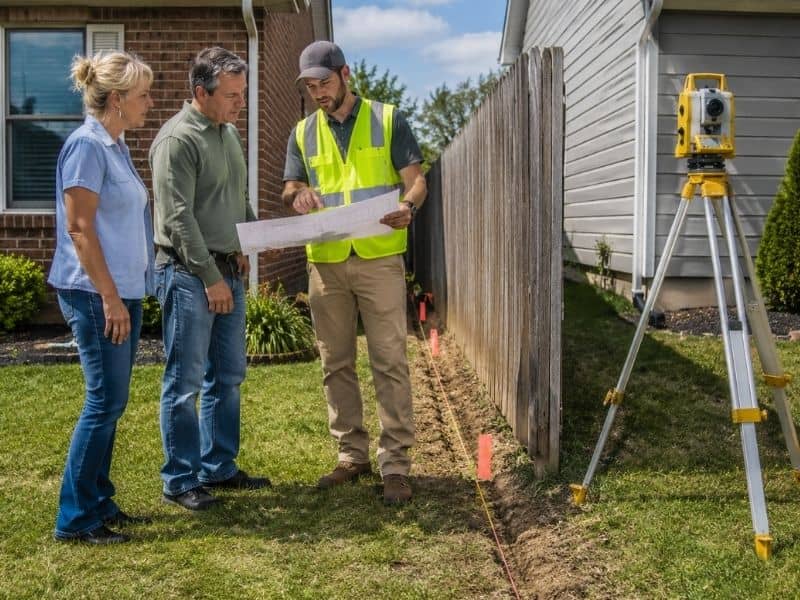
Land surveyor reviewing a property boundary map with homeowners beside a fence line to help resolve a neighbor property dispute

Few things create tension between neighbors faster than a disagreement over where one property ends and another begins. Whether the issue involves a fence, a driveway, or a structure that crossed the line, disputes can escalate quickly if not handled correctly.

Most property line disputes can be resolved without going to court. The key is knowing the right steps and acting on them early.

What Causes Property Line Disputes?

Most boundary disputes come down to one of a few common situations.

Unclear deed descriptions. Older deeds often use vague language to describe boundaries. Phrases like “along the old fence line” or “to the large oak tree” leave room for interpretation, especially when the fence is gone or the tree no longer exists.

Missing or moved survey monuments. Physical corner markers such as iron pins or concrete posts can be removed during construction, buried over time, or shifted accidentally. When markers are missing, both neighbors may have different ideas about where the line falls.

Assumptions based on existing features. Fences, hedges, and landscaping are often treated as property lines, but they are not always in the right place. A fence installed decades ago may have been placed incorrectly from the start.

Errors in recorded documents. Mistakes in deeds, plats, or subdivision maps do occur. When two neighboring deeds overlap or leave a gap, disputes are almost inevitable.

Signs You May Have a Boundary Problem

Not every boundary issue starts with a heated argument. Watch for these warning signs:

  • A neighbor builds a fence, shed, or addition that appears to cross onto your land
  • You receive a notice from a contractor or surveyor working on the property next door
  • A title search during a sale reveals conflicting boundary descriptions
  • You and your neighbor disagree about where a shared driveway or walkway belongs
  • Someone is regularly using a portion of your land without permission

If any of these situations apply, it is worth taking action sooner rather than later.

Step 1: Review Your Deed and Plat Map

Before approaching your neighbor or calling anyone else, start with your own documents. Pull out your property deed and your recorded plat map. These are public records available at your county recorder or assessor’s office.

Read through the legal description of your property. It will describe your boundary using measurements, directions, and reference points. Knowing what your documents say is an essential first step.

Step 2: Have a Calm Conversation With Your Neighbor

In many cases, boundary issues are the result of a genuine misunderstanding rather than bad intentions. Your neighbor may have no idea that their fence or addition is in the wrong place.

Before things become formal, try a direct and respectful conversation. Share what your deed says and ask if they have their own documents to compare. You may find that both of you are working from different assumptions, and a simple discussion can open the door to a cooperative solution.

Step 3: Hire a Licensed Land Surveyor

This is the most important step in resolving any boundary dispute. A licensed professional land surveyor will research the deed history of both properties, locate or re-establish physical corner markers, and produce a legally recognized map showing the true boundary line.

A survey removes the guesswork. Instead of two neighbors arguing based on assumptions, you have an official document based on recorded deeds. In most cases, one party accepts the findings and the matter is resolved. Even when both neighbors share the cost, a survey is far less expensive than a legal dispute.

Step 4: Attempt a Negotiated Agreement

If the survey confirms a boundary that one neighbor disagrees with, a negotiated agreement is often the next practical option. This could take the form of:

  • A boundary line agreement, where both parties formally agree to accept a specific line, recorded with the county
  • A quitclaim deed, where one party transfers any claim to a disputed strip of land to the other
  • A license or permission agreement, which allows one party to use a portion of land under agreed-upon terms

These agreements should always be put in writing and recorded with the county. An attorney can help draft the appropriate documents.

Step 5: Consult a Real Estate Attorney

If the dispute cannot be resolved through conversation or negotiation, it is time to involve a real estate attorney. An attorney can review the survey, assess your options, and help you pursue a formal resolution.

In some cases, this may lead to a court action known as a quiet title suit, where a judge reviews the evidence and issues a ruling that legally establishes the boundary. This is typically a last resort, but when a neighbor refuses to accept a survey’s findings or has clearly encroached on your land, legal action may be necessary.

How to Prevent Future Disputes

Once your boundary is resolved, take steps to protect yourself going forward.

  • Make sure your corner monuments are visible and in place
  • Record any boundary agreements with your county
  • Keep copies of your survey, deed, and signed agreements in a safe place
  • Confirm the boundary before building anything near a property line in the future

Frequently Asked Questions

What if my neighbor refuses to accept the survey results? 

You may need to consult a real estate attorney. In serious cases, a court can issue a ruling based on the survey and deed evidence.

Can a fence determine a property line legally? 

Not on its own. A fence is not legal evidence of a boundary. However, if a fence has been treated as the line by both parties for many years, it may become relevant in a legal dispute. An attorney can explain how this applies in your state.

What is adverse possession? 

Adverse possession is a legal concept that allows someone to claim ownership of land they have openly used for a set number of years, even without permission. Rules vary by state. If someone has been using part of your property without your knowledge, consult an attorney to understand your options.

Posted in boundary surveying | Tagged boundary survey

Types of Land Surveys Explained

Bridgeport Land Surveying Posted on May 27, 2026 by BridgeportSurveyorMay 27, 2026
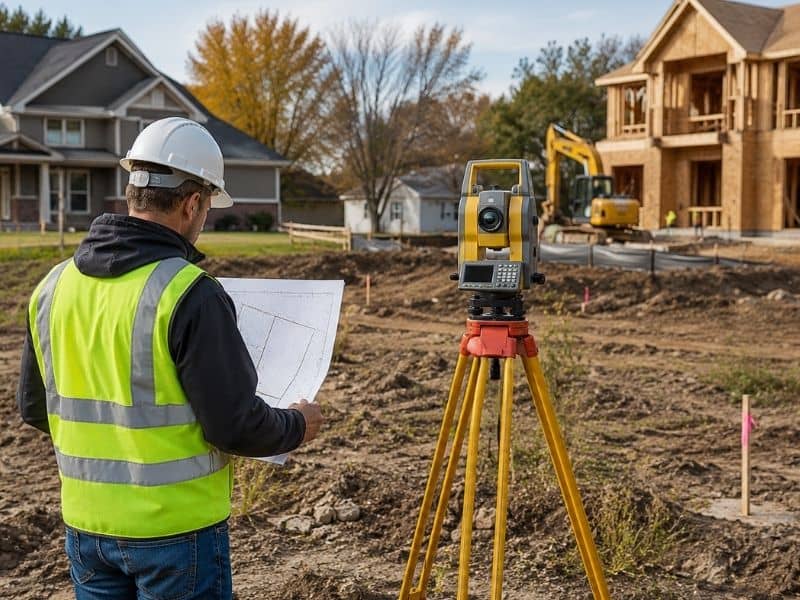
Licensed land surveyor reviewing site plans beside survey equipment at a residential and construction development project

If you have ever been told you need a land survey, your first question is probably: what kind? There are several types of land surveys, and each one serves a different purpose. Ordering the wrong type can delay your project, cost extra money, or fail to meet the requirements of your lender, builder, or local government.

Boundary Survey

A boundary survey is the most common type of land survey. Its purpose is to locate and confirm the legal corners and edges of a property.

A licensed surveyor researches the property deed, reviews recorded plat maps, and then goes into the field to find or re-establish the physical corner markers. The result is a map showing the exact legal lines of the property.

Who needs it: Anyone who wants to know exactly where their property begins and ends. This survey is most commonly ordered for residential properties, especially when building near a property line, resolving a neighbor dispute, or confirming what you are buying before a real estate closing.

Topographic Survey

A topographic survey maps the physical features of a piece of land. Instead of focusing on legal boundary lines, it records the natural and man-made features of the land’s surface, including elevation changes, slopes, trees, bodies of water, roads, and existing structures. The result is a detailed map showing contour lines that represent changes in elevation across the property.

Who needs it: Architects, engineers, and developers use topographic surveys at the start of any construction or site planning project. If you are designing a new building, planning drainage, or grading a site, a topographic survey is typically required before design work begins. Homeowners planning significant landscaping or drainage improvements may also need one.

ALTA/NSPS Survey

An ALTA/NSPS survey, short for American Land Title Association and National Society of Professional Surveyors survey, is the most detailed and comprehensive type of land survey available. It combines boundary information with additional data points required by title companies and lenders for commercial real estate transactions.

An ALTA survey identifies property boundaries, easements, encroachments, improvements, utilities, and zoning classifications. It follows a strict national standard, which means its format is consistent regardless of which state it is prepared in.

Who needs it: ALTA surveys are most often required for commercial property purchases and refinancing of commercial properties. They are rarely needed for standard residential transactions but are considered standard practice in commercial real estate.

Mortgage Survey

A mortgage survey, sometimes called a location survey, is a simplified drawing that shows the position of a structure on a lot relative to the property lines. It does not set physical monuments in the ground and is less detailed than a boundary survey.

Its main purpose is to give a lender confidence that a home or building sits within the property boundaries and does not obviously encroach on neighboring land.

Who needs it: Lenders sometimes require a mortgage survey as part of a residential closing. It is important to understand that a mortgage survey is not the same as a boundary survey. It will not resolve a property line dispute and is not accepted by courts or building departments as legal boundary evidence.

Construction Survey

A construction survey is performed during the building process to ensure that structures are placed in the correct location according to approved plans. Surveyors stake out the positions of foundations, roads, utilities, and other improvements before and during construction.

This is an ongoing service rather than a one-time document. Surveyors may visit a site multiple times as different phases of the project are completed.

Who needs it: Contractors, developers, and engineers working on new construction, road building, or utility installation. Without a construction survey, even a small placement error early in a project can lead to expensive corrections later.

Subdivision Survey

A subdivision survey is used when a larger parcel of land is being divided into two or more separate lots. The surveyor measures the original parcel, designs the new lot layout according to local zoning regulations, and produces a plat map that must be reviewed and approved by the local government before it can be recorded.

Once recorded, each new lot has its own legal description and can be sold or developed on its own.

Who needs it: Landowners who want to divide their property to sell part of it, developers creating new residential or commercial lots, and anyone going through the legal process of separating a combined parcel into individual pieces.

How to Choose the Right Survey

The type of survey you need depends on what you are trying to accomplish. Here is a simple breakdown:

  • Buying or selling residential property: Boundary survey or mortgage survey, depending on lender requirements.
  • Buying or selling commercial property: ALTA/NSPS survey.
  • Planning a new building or development: Topographic survey, followed by a construction survey during building.
  • Dividing land into separate lots: Subdivision survey.
  • Resolving a property line question: Boundary survey.

When in doubt, call a licensed land surveyor and describe your situation. A good surveyor will tell you exactly which type of survey fits your needs.

Frequently Asked Questions

Do I always need a survey when buying property? 

Not always, but it is strongly recommended, especially for vacant land or properties with no recent survey history. Your lender or title company may require one depending on the transaction.

Can one survey serve multiple purposes? 

Sometimes. An ALTA survey covers boundary information along with several other requirements, making it useful for multiple parties in a commercial transaction. Ask your surveyor what can be combined to save time and cost.

How long does a land survey take? 

A standard residential boundary survey typically takes a few days to a couple of weeks, depending on the parcel size and complexity. More detailed surveys such as ALTA or subdivision surveys can take longer.
Posted in land surveying | Tagged Land Surveying

Are Property Lines on Google Maps Accurate?

Bridgeport Land Surveying Posted on May 25, 2026 by BridgeportSurveyorMay 27, 2026
Land surveyor checking a residential property boundary while comparing survey markers with a digital property map

The short answer is no. Google Maps does not show accurate property lines. The boundary lines you see on Google Maps or Google Earth are pulled from public GIS (Geographic Information System) databases maintained by county tax offices. These records are meant for general reference only, and they carry no legal weight. If you are making decisions about your land based on what you see in Google Maps, you could be setting yourself up for a costly mistake.

What Does Google Maps Actually Show?

When you zoom into a property on Google Maps, you may notice faint lines outlining what looks like your lot. Many people assume these are their official property lines. In reality, they are rough approximations pulled from county tax assessor and GIS records.

These databases were not designed for land surveying. They exist to help government offices track property ownership for tax purposes. The data is often digitized from older plat maps, and counties update it at different rates. Some areas refresh their GIS records regularly, while others may go years without corrections. By the time that data reaches Google Maps, it can be significantly out of date.

Why These Lines Cannot Be Trusted

There are three main reasons why Google Maps property lines are not reliable for legal or construction purposes.

The data is not survey-grade. A professional land survey uses precision instruments such as GPS receivers and total stations to measure land with centimeter-level accuracy. GIS parcel data does not come close to that level of precision. The lines in Google Maps are digitized estimates, not field measurements.

The information is often outdated. If a property was subdivided, re-platted, or had a boundary change recorded, that update may not appear in the county GIS database for months or even years. Google Maps simply reflects whatever the county has on file, including errors.

It has no legal standing. No court, title company, lender, or building department will accept a Google Maps screenshot as proof of a property boundary. The only document that legally defines where your property begins and ends is a survey prepared and sealed by a licensed professional land surveyor.

How Far Off Can the Lines Be?

The error can range from a few feet to several dozen feet, depending on the area and the age of the records.

In urban and suburban neighborhoods, Google Maps lines might look close to correct but could still be off by 2 to 10 feet. That may not sound like much, but a 5-foot error near a property line can mean the difference between a legal fence and an encroachment on your neighbor’s land.

In rural areas, errors are often larger. Older properties described by metes and bounds, a method that uses directions and distances rather than a standard grid, are especially prone to misrepresentation in GIS systems. Errors of 20 to 50 feet are not unusual for rural parcels.

The Risks of Relying on Google Maps

Using Google Maps to make decisions about your property can lead to serious problems. Here are the most common issues homeowners face:

  • Fence and structure encroachments. Building on land you believe is yours, but is not, can result in removal orders and legal disputes with your neighbor.
  • Permit denials. Building departments require structures to meet setback requirements measured from legal property lines. Google Maps lines are not accepted for this purpose.
  • Failed real estate closings. Buyers and lenders require accurate surveys before a sale is finalized. A Google Maps printout will not satisfy that requirement.
  • Neighbor disputes. Assumptions based on Google Maps frequently lead to disagreements that require surveyors or attorneys to resolve, which adds time and expense.

The Right Way to Find Your Property Lines

The only reliable and legally recognized way to find your property lines is to hire a licensed professional land surveyor to perform a boundary survey.

A boundary survey involves researching your deed, reviewing recorded plat maps, locating existing survey monuments in the field, and using precision equipment to measure and confirm your property corners. At the end of the process, the surveyor will mark your corners with physical monuments such as iron pins or concrete posts. You will also receive a survey map that can be recorded with your county.

This is the document that holds up in court. It is what your title company, lender, and building department will accept. No online tool or satellite image can replace it.

When Should You Order a Boundary Survey?

You should consider getting a boundary survey in these situations:

  • Before purchasing a piece of land or vacant property
  • Before building a fence, shed, garage, or addition near your property line
  • When a neighbor questions where your boundary is
  • When applying for a building permit that requires setback documentation
  • When dividing or selling part of your land
  • When resolving a title issue during a real estate transaction

Frequently Asked Questions

Can I use Google Earth instead of Google Maps for property lines? 

No. Google Earth uses the same GIS parcel data and has the same limitations. Neither platform provides legally accurate boundary information.

Are county GIS websites more accurate than Google Maps? 

County GIS portals are often more current than Google Maps, but they are still administrative records, not survey-grade data. They should not be used for construction, legal, or real estate decisions.

How much does a boundary survey cost? 

Costs vary based on parcel size, terrain, and the complexity of the deed description. Most residential boundary surveys in the United States range from $500 to $2,500. Contact Bridgeport Land Surveying for a quote specific to your property.

Posted in land surveying

Post navigation

← Older posts
Get Quote Button
© Bridgeport Land Surveying
Bridgeport, West Virginia
Phone: (304) 933-6002

Web Development and SEO by:
N2Biz.co


Privacy Policy | Terms of Use

The owner of this website, USA Surveying & Engineering, LLC., provides coordination of professional land surveying and engineering services in all 50 states. The professional surveying and engineering services provided to you will be conducted by fully licensed professionals in your state.

↑